
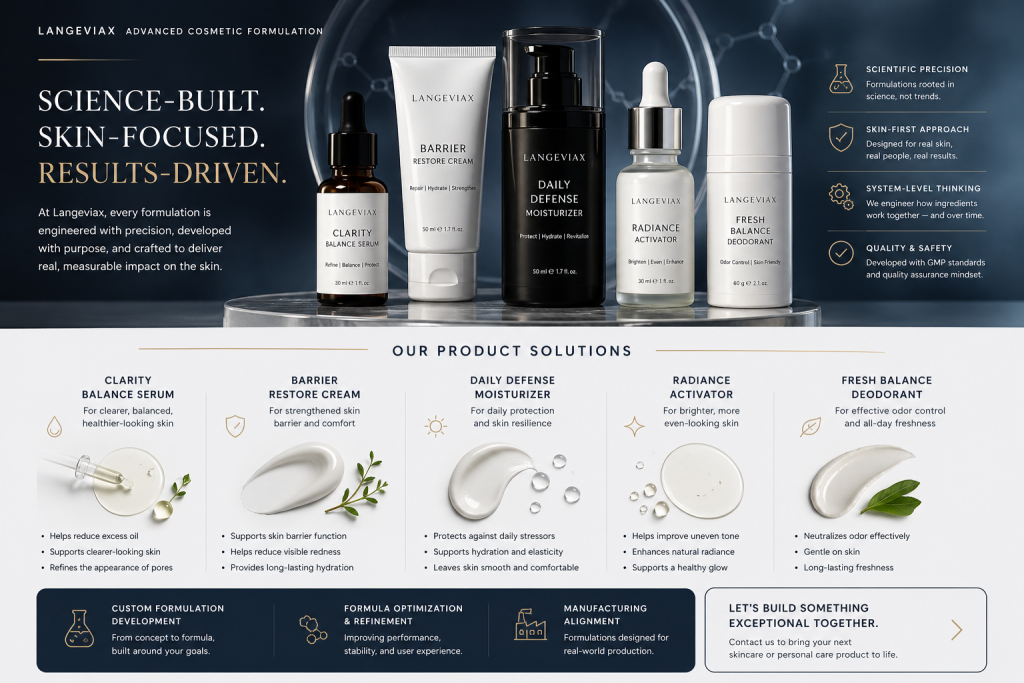
At Langeviax, we are not interested in simply recreating formulas that already exist. The world does not need more copies — it needs smarter, safer, and more advanced cosmetic products. Our mission is to develop new formulations with scientific purpose, real differentiation, and long-term performance in mind.
LANGEVIAX — Advanced Cosmetic Formulation
Introduction
At Langeviax, we approach skincare differently.
We don’t begin with trends.
We don’t begin with marketing.
We begin with understanding how skin responds to systems — not products.
Our work is built on a foundation of pharmaceutical thinking, formulation science, and real-world manufacturing knowledge.
Every formulation we develop is designed with precision, intention, and long-term performance in mind.
Because in reality, most products don’t fail loudly.
They fail quietly — by doing less than they promise.
We exist to close that gap.
What We Do
We support individuals, startups, and established brands in building high-performance cosmetic products through:
Custom formulation development
Formula refinement and optimization
Stability and system-level correction
GMP and quality-aligned product development
Technical guidance for production readiness
Every project is approached as a system — not just a product.
How We Think
We don’t see formulations as a list of ingredients.
We see them as dynamic systems where:
Structure defines behavior
Environment defines performance
Interaction defines outcome
This perspective allows us to design products that function consistently — not just theoretically.
Why Our Approach Is Different
In a market where many products look similar on the surface,
true differentiation rarely comes from what is visible.
Our approach is different because it operates at a deeper level:
We design for behavior, not appearance
We focus on performance over claims
We align formulation with real manufacturing conditions
We think in terms of systems, not components
This integration of clinical understanding, formulation engineering, and quality systems creates a level of precision that is rarely found in conventional product development.
Not louder.
Not trend-driven.
Just fundamentally more controlled — and more effective.
Working With Us
Whether you are building a new product or refining an existing one,
we work with you to create something that performs — not just exists.
Quietly engineered.
Precisely developed.
Professionally delivered.
Call To Action
Start the conversation.
Tell us what you’re building —
and we’ll help you understand what it could become.
فرم ثبتنام ورکشاپ آموزشی
چگونه محصولات آرایشی و بهداشتی خوب را از محصولات ضعیف و مضر تشخیص دهیم؟
مهدی امامدوست، MSc Pharm
داروساز آموزشدیده و دارای سابقه فعالیت حرفهای در ایران
با سابقه مدیریت تضمین کیفیت، فرمولاسیون و کنترل کیفیت در صنایع آرایشیبهداشتی در کانادا
درباره ورکشاپ
در این ورکشاپ یاد میگیرید که کیفیت یک محصول را فقط از روی نام برند، قیمت یا تبلیغات قضاوت نکنید.
گاهی حتی برندهای بسیار معروف و گرانقیمت دنیا نیز ممکن است محصولاتی با ترکیبات ضعیف، تحریککننده یا نامناسب تولید کنند؛ در مقابل، بعضی برندهای کمتر شناختهشده میتوانند محصولات علمیتر، مؤثرتر و باکیفیتتری داشته باشند.
استفاده از محصولات آرایشی، پوستی و موی نامناسب میتواند به مرور زمان به پوست آسیب بزند، روند پیری پوست را سریعتر کند و در برخی موارد نگرانیهایی برای سلامت عمومی ایجاد کند.
در این ورکشاپ یاد میگیرید:
- فرق بین تبلیغات بازاریابی و واقعیت علمی را تشخیص دهید
- محصولات باکیفیت را از محصولات ضعیف یا آسیبرسان شناسایی کنید
- فرمهای مؤثر و ضعیف مواد مهمی مانند ویتامین سی، رتینول و هیالورونیک اسید را بشناسید
- اشتباهات رایج هنگام خرید محصولات پوستی را تشخیص دهید
- برای پوست حساس، مستعد لک یا آکنه انتخاب بهتری داشته باشید
- هنگام خرید محصول، معیارها و شاخصهای مهم را در نظر بگیرید
اطلاعات ورکشاپ
مدت زمان: ۹۰ دقیقه
هزینه ثبتنام: ۴۹ دلار کانادا
تاریخ، ساعت و محل برگزاری متعاقباً اعلام خواهد شد.
فرم ثبتنام
Workshop Registration Form
How to Identify High-Quality Cosmetic and Skincare Products from Harmful or Poor-Quality Ones
Mahdi Emamdoost, MSc Pharm
Pharmacy-trained professional with previous professional experience in Iran
Experienced in Quality Assurance, Formulation, and Quality Control in the Cosmetic Industry in Canada
About the Workshop
In this workshop, you will learn why product quality should not be judged only by brand name, price, or marketing claims.
Even some famous and expensive brands may produce products with weak, irritating, or poorly designed formulations. On the other hand, some lesser-known brands may offer more scientific, effective, and higher-quality products.
Using inappropriate skincare, cosmetic, or haircare products may gradually damage the skin, accelerate premature aging, and raise concerns about overall health.
What You Will Learn
- Understand the difference between marketing claims and scientific reality
- Identify high-quality products from poor or potentially harmful ones
- Recognize effective and weak forms of ingredients such as Vitamin C, Retinol, and Hyaluronic Acid
- Avoid common mistakes when purchasing skincare products
- Choose better products for sensitive, acne-prone, or pigmentation-prone skin
- Understand the key criteria and indicators when selecting skincare products
Workshop Information
Duration: 90 minutes
Registration Fee: 49 CAD
Date, time, and location will be announced soon.
Registration Form
Mahdi Emamdoost, MSc Pharm
Pharmacist | Cosmetic Product Developer | Quality Assurance Manager | Author
His professional background spans cosmetic formulation, GMP-compliant manufacturing, Quality Management Systems (QMS), product innovation, stability programs, supplier qualification, and regulatory affairs. Having worked directly within manufacturing environments, he has participated in the development, evaluation, quality oversight, and commercialization of skincare and personal care products.
As the founder of LANGEVIAX, his mission is to bridge the gap between cosmetic science and consumer understanding—helping brands build better products and helping consumers make more informed decisions.
**Areas of Expertise**
• Cosmetic Formulation & Product Development
• Quality Assurance (QA) & Quality Systems
• Quality Control (QC) & Product Evaluation
• GMP & Regulatory Compliance
• Brand Development & Product Innovation
• Cosmetic Manufacturing & Commercialization
• Consumer Education & Cosmetic Science Communication
• Author & Industry Educator
“Science should not stay behind laboratory doors. It should help people make better decisions every day.”
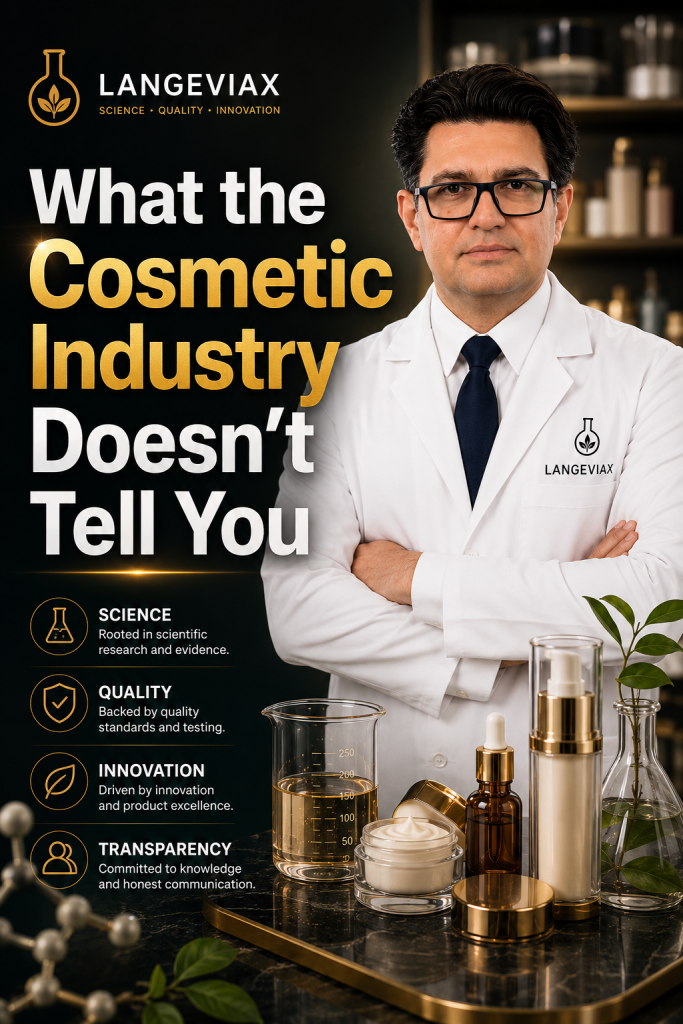
9 Important Truths About Skincare and Haircare Products
Years of experience in cosmetic formulation, Quality Assurance (QA), Quality Control (QC), and product development have taught me one important lesson:
Many of the factors that determine the true quality of a cosmetic product are never printed on the packaging.
Most consumers focus on marketing claims, trending ingredients, and attractive branding. However, behind the scenes, formulators, quality professionals, and product developers evaluate products through a very different lens.
The following insights may completely change the way you look at skincare and haircare products.
1. The First Five Ingredients Tell the Real Story
One of the most common mistakes consumers make is searching for a single “hero ingredient” such as hyaluronic acid, niacinamide, retinol, or vitamin C.
When a professional formulator evaluates a product, however, the first thing they often examine is the first five to ten ingredients on the ingredient list.
Why?
Because in most cosmetic products, ingredients are listed in descending order of concentration. This means that the first few ingredients typically make up the majority of the formula.
A product may prominently advertise:
“With Hyaluronic Acid”
Yet the hyaluronic acid may appear near the end of the ingredient list.
This does not necessarily mean the ingredient is ineffective. However, it does remind us that marketing claims do not always reflect the true composition of a product.
Professional formulators look beyond the marketing and focus on the structure of the formula itself.
2. The Most Expensive Ingredient Is Not Always the Most Effective
The beauty industry loves luxury stories.
Gold, caviar, diamond powder, rare botanical extracts, and exotic ingredients are often marketed as premium solutions.
However, many of the most scientifically supported ingredients in skincare are surprisingly simple:
Glycerin
Niacinamide
Urea
Panthenol
The true value of an ingredient is not determined by its price tag or rarity. It is determined by scientific evidence, formulation design, and real-world performance.
In some cases, a well-formulated $20 moisturizer may outperform a $200 luxury cream.
3. The Formula Matters More Than the Ingredient
This is one of the industry’s biggest secrets.
Consumers often ask:
“What is the best skincare ingredient?”
Professionals ask a different question:
“What is the best formulation?”
Two products may both contain 5% niacinamide and deliver completely different results.
Why?
Because performance depends on much more than the ingredient itself.
Factors such as:
pH
Solvent systems
Emulsion design
Ingredient stability
Skin penetration
Ingredient compatibility
all influence how a product performs.
Formulation is not simply mixing ingredients together—it is the science of making those ingredients work effectively and consistently.
4. “Paraben-Free” Does Not Automatically Mean Better
Few marketing claims have been as successful as “Paraben-Free.”
For years, many consumers have assumed:
Paraben-Free = Safer
The reality is more nuanced.
Parabens have been used in cosmetic products for decades and are still considered by many formulation experts to be among the most effective and reliable preservative systems available.
Removing an ingredient because of marketing trends does not automatically improve a product.
What matters is the safety, effectiveness, and overall performance of the preservative system—not the popularity of the claim on the label.
5. Most Consumers Never Think About pH
Yet formulators think about it constantly.
Even an excellent formula can fail if its pH is poorly designed.
An inappropriate pH can:
Irritate the skin
Reduce ingredient effectiveness
Destabilize the formulation
Shorten product shelf life
This is why pH is often considered just as important as the active ingredients themselves.
6. Shelf Life Depends on More Than Preservatives
Many people assume that preservatives alone determine how long a product lasts.
In reality, product stability depends on multiple factors:
Packaging design
Formula composition
Storage conditions
Consumer use patterns
Stability testing
Microbiological challenge testing
Professional cosmetic products undergo extensive testing to ensure they remain safe, effective, and stable throughout their intended shelf life.
7. Packaging Can Destroy a Great Formula
Sometimes the problem is not the formula.
It is the packaging.
For example:
Vitamin C is sensitive to air and light.
Retinol degrades when exposed to oxygen.
Certain dispensers allow repeated air exposure.
A poorly chosen package can significantly reduce the effectiveness of an otherwise excellent product.
This is why product developers evaluate packaging with the same level of attention they give to formulation.
8. Many “Different” Products Are Surprisingly Similar
This is one of the least understood realities of the cosmetic industry.
Many products that appear completely different on the shelf are built on very similar foundational formulas.
In some cases, the differences may be limited to:
Fragrance
Color
Packaging
Marketing claims
Minor ingredient adjustments
This does not necessarily make them poor products.
However, it demonstrates that branding and formulation are not always the same thing.
True innovation occurs when a product is developed from the ground up around a specific consumer need, scientific rationale, and competitive advantage.
9. “Natural” Does Not Always Mean Safer or Better
Many consumers assume that natural ingredients are inherently superior.
From a scientific and quality perspective, the reality is more complex.
Natural ingredients can sometimes be:
Irritating
Allergenic
Less stable
More variable in quality
At the same time, many synthetic ingredients have been extensively studied and possess excellent safety profiles.
The most important criteria are not whether an ingredient is natural or synthetic.
The most important criteria are:
Safety
Effectiveness
Stability
Scientific evidence
These factors determine whether an ingredient deserves a place in a well-designed formulation.
Final Thoughts
Consumers often see ingredient names.
Product developers see formulation architecture.
The true quality of a skincare or haircare product is rarely determined by a single trendy ingredient, a luxury claim, or an attractive package.
Quality is the result of science, formulation expertise, stability, safety, quality systems, and a deep understanding of consumer needs.
At LANGEVIAX, our mission is to help consumers and brands look beyond marketing claims and understand what truly makes a cosmetic product effective, reliable, and worth choosing.
Because better decisions begin with better knowledge.
Lorem ipsum dolor sit amet, consectetur adipiscing elit. Ut elit tellus, luctus nec ullamcorper mattis, pulvinar dapibus leo.